


Ethereum buyers face network choices
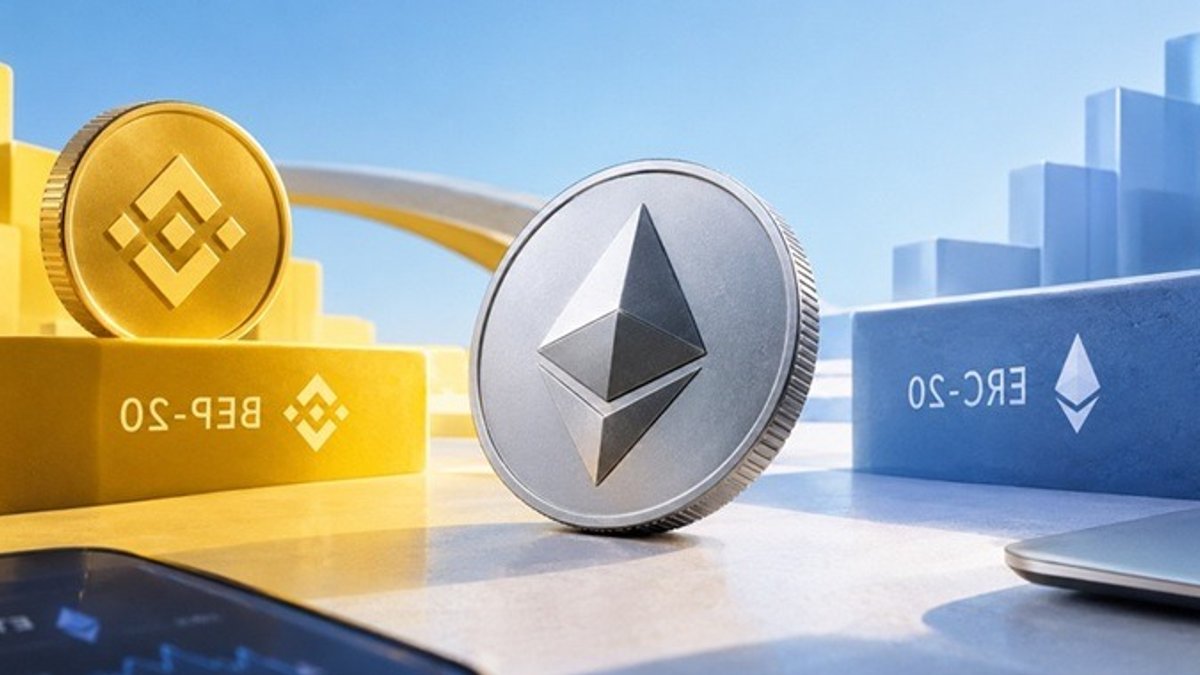
When buying Ethereum in 2026, most exchanges and wallets offer it on more than one network, often listing “Ethereum (ERC-20)” next to “BNB Smart Chain (BEP-20)” under the same ticker and price. Behind these labels sit two separate ledgers with their own fees, backing, and recovery rules.
The “ERC-20” label refers to the Ethereum network, where ETH is the native currency used to pay gas and stake for network security. In contrast, BEP-20 ETH is a token issued by Binance on the BNB Smart Chain, backed by ETH in Binance’s reserves.
ERC-20 vs BEP-20 ETH: What Assets Are Behind the Labels
A purchase on either network results in an ETH balance in the wallet, but the asset behind that label depends on the chain it sits on. The Ethereum network uses the ERC-20 token standard, while BNB Smart Chain applies a similar wrapping idea with a company holding the collateral.
Binance’s Binance-Peg Ethereum Token on BNB Smart Chain is designed to be backed by one ETH in its reserves, which the exchange reports on a collateral page within its proof-of-reserves data. The token’s value depends on Binance keeping those reserves and honoring redemptions.
Read Also: U.S. CFOs’ Optimism Grows Amid Economic Gains, AI Boost
Both networks run the Ethereum Virtual Machine and derive addresses from the same key cryptography, so one address in a wallet like MetaMask or Trust Wallet is valid on Ethereum and on BNB Smart Chain, with chain IDs 1 and 56 keeping their transactions apart.
Ethereum vs BNB Smart Chain: Network Differences
Although both chains run the same virtual machine, they differ in terms of gas, validator control, and app support. Ethereum’s rollups add a third destination, with networks like Arbitrum, Base, and Optimism offering lower fees for small transactions.
A comparison of the two networks shows that Ethereum mainnet uses native ETH, while BNB Smart Chain uses Binance-Peg ETH, which is backed by Binance’s reserves. The typical transfer cost on Ethereum mainnet can range from cents to a few dollars, while on BNB Smart Chain it is a fraction of a cent.
The choice of network affects the buyer’s experience, with long-term holders and those who want to stake their ETH preferring the Ethereum mainnet, while users of PancakeSwap or Venus may prefer BEP-20 ETH on the BNB Smart Chain.
Read Also: Citi and Coinbase expand payment collaboration
For frequent small transfers, an L2 network like Arbitrum or Base may be a better option, with fees in cents and faster transaction times. The network choice also affects the recovery process in case of a mistake, with self-custody addresses generated from a seed phrase working on every EVM chain, but exchange deposit addresses controlled by the exchange.
According to the US Department of Justice, Binance agreed to a $4.3 billion penalty in November 2023, which may impact the stability of BEP-20 ETH. Additionally, regulatory changes like MiCA may affect the supported networks on platforms, with transitional periods for crypto-asset service providers ending no later than July 1, 2026.
Cross-chain tooling is also evolving, with intent-based bridges and messaging layers allowing for easier asset transfer between chains. This may shift the network decision from users to wallet and exchange software, making it easier for buyers to choose the right network for their needs.
The Ethereum Foundation has announced several upgrades, including Pectra and Fusaka, which have increased the blob target and rollup data capacity, reducing fees on L2 networks. This has reduced the fee advantage of BEP-20 ETH for small transfers, making L2 networks a more attractive option for frequent transactions.
Read Also: Ripjar boosts AI in customer screening tools
Exchanges like ChangeNOW offer direct ETH withdrawals to Arbitrum, Base, or Optimism, making it easier for buyers to choose the right network for their needs. However, the wrong-network problem can still occur, with users withdrawing ETH to the wrong network and facing recovery issues.
In one example, a user withdrew ETH from Binance over BEP-20 and saw no new balance, only to discover that the funds had reached the right address on BNB Smart Chain while the wallet was set to Ethereum. Adding the BSC network and moving the funds required BNB for gas, which the wallet did not hold.
Security and control of the chain are key differences between Ethereum and BNB Smart Chain. BNB Smart Chain uses Proof of Staked Authority, where a small set of validators produces blocks, whereas Ethereum has a large, open validator set. This difference was highlighted in 2022 when an attacker exploited the Token Hub bridge, and validators halted the chain within hours, limiting the damage.
Recovery and Network Choice
Recovery of misrouted funds depends on who holds the key. Bridges have been vulnerable to large losses, including the $625 million Ronin Bridge exploit in 2022 and the collapse of Multichain in 2023.


